Mazda · Build & Price
Simplifying a complex vehicle configuration experience, resulting in higher engagement and stronger purchase intent conversions.
Mazda · Build & Price
Simplifying a complex, multi-step vehicle configuration experience to improve clarity, confidence, and conversion.

Project at a Glance
My Role: Lead UX Product Designer, end-to-end design including research, design strategy, prototyping, testing, and cross-functional alignment.
Team: Product, engineering, analytics, and marketing
Goal: Increase engagement and conversions through improved clarity, confidence, and build completions across a complex, multi-step flow.
Outcomes: Increased engagement and build completion (+12%), drove higher conversion (+66% inventory views, +17% quote requests), and improved brand perception (+14%).
The Challenge
Mazda’s existing Build & Price tool was underperforming. Users struggled to explore vehicle customizations, understand how upgrades and features interacted, and did not progress to request a quote, view inventory, or contact a dealer. We redesigned the experience with the goal to improve user engagement, increase conversion rates, and raise customer satisfaction.
Research
Analyzed site analytics to identify drop-off points, revealing that users most frequently abandoned during early configuration steps. This helped us realize that we needed to display feature upgrades, inventory, and pricing earlier in the process.
Conducted a heuristic evaluation of the existing experience, uncovering usability gaps and missed upgrade opportunities caused by unclear feature hierarchy and insufficient details at key decision points.


Reviewed competitor experiences, identifying effective patterns for progressive disclosure, comparison, and contextual guidance that helped users make confident decisions.
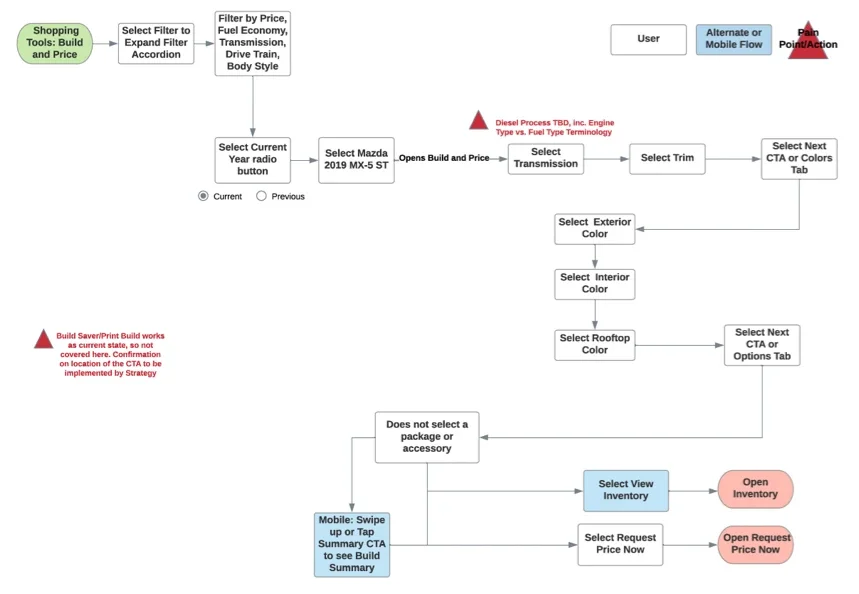
Mapped user journeys across the build flow, identifying friction and how pricing and configuration decisions affected user confidence and completion.
Conducted user testing on early concepts to validate assumptions, assess clarity, and inform interactions before moving into higher-fidelity designs.
Key Research Takeaways
Users need context around upgrades and the impact on pricing to instill confidence.
Complexity increased as builds progressed; not enough guidance and reinforcement led to hesitation and abandonment.
Surfacing trade-offs and selections persistently increased confidence to complete the build.
These insights informed a redesign focused on clarity, progressive disclosure, and confidence-building throughout the experience.
Iterative Design
Created interactive prototypes to explore alternative flows, feature groupings, and upgrades, allowing the team to test ideas quickly.
Tested concepts with users to evaluate ease of use, clarity around feature selection and upgrades, and overall confidence at key decision points.
Refined the experience across iterations by
Simplifying navigation and step progression
Making selections persistent and easily reviewable
Enhancing visual feedback to clarify upgrade value
Improving the visibility and timing of pricing and inventory
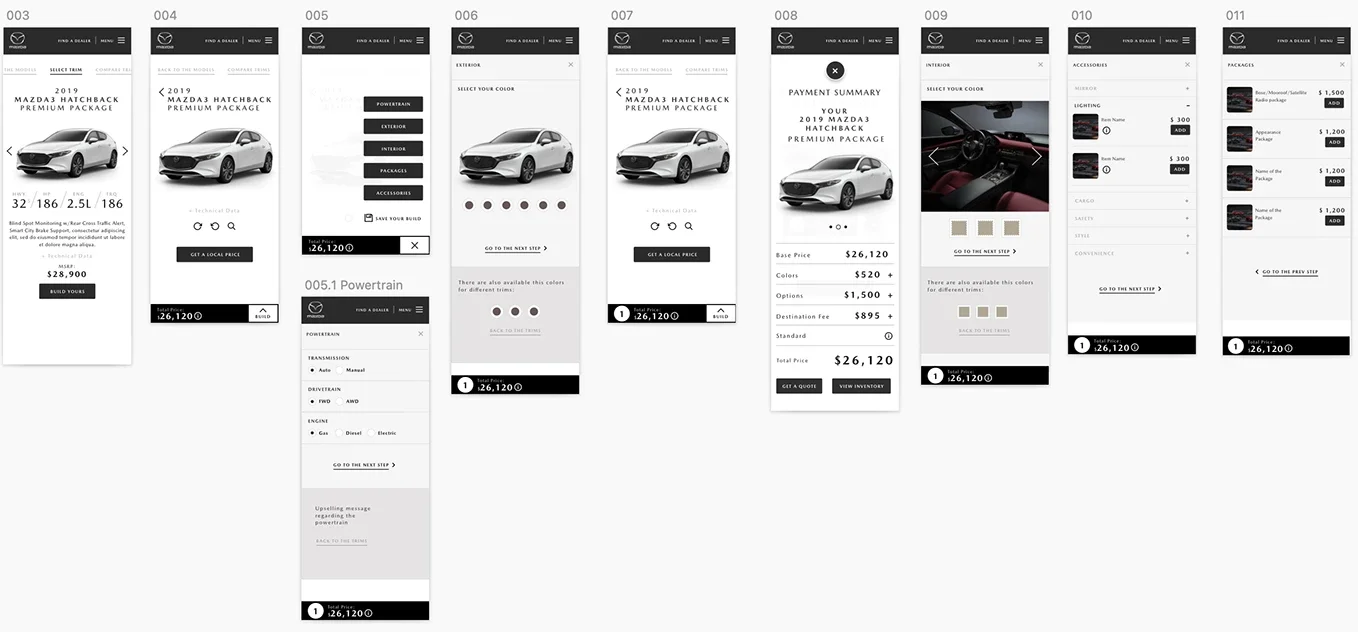
Through early prototypes, we tested key interactions and optimized the flow to create a seamless, flexible experience.
Impact
The redesigned Build & Price tool delivered measurable improvements
Improved Engagement — more time spent on the tool and a 12% increase in build completions
Higher Conversion Rates — 66% increase in inventory views and 17% increase in quote requests after using the tool
Brand Satisfaction — 14% improvement in opinion of Mazda since launch
““The new build and price tool is fantastic and gives you a true sense of what it would be like to be sitting in the vehicle as your own.” ”

Learnings
User engagement is driven by clarity and exploration — giving users freedom to explore, visualize upgrades and see how their choices impact price and inventory encourages deeper interaction.
Persistence and transparency matter — when users understand how the tool works, are alerted of ripple effects, and can navigate flexibly, drop-off decreases.
Competitor benchmarking is invaluable — by analyzing how rival brands implement similar tools we identified best practices and opportunity gaps.
Measure and iterate early and often — by prototyping early, testing and iterating we avoided major missteps and made improvements based on real user behavior, not just assumptions.
Qualitative feedback complements quantitative metrics — hearing what users feel about the tool helps capture brand and experience opportunities not visible in numbers alone.